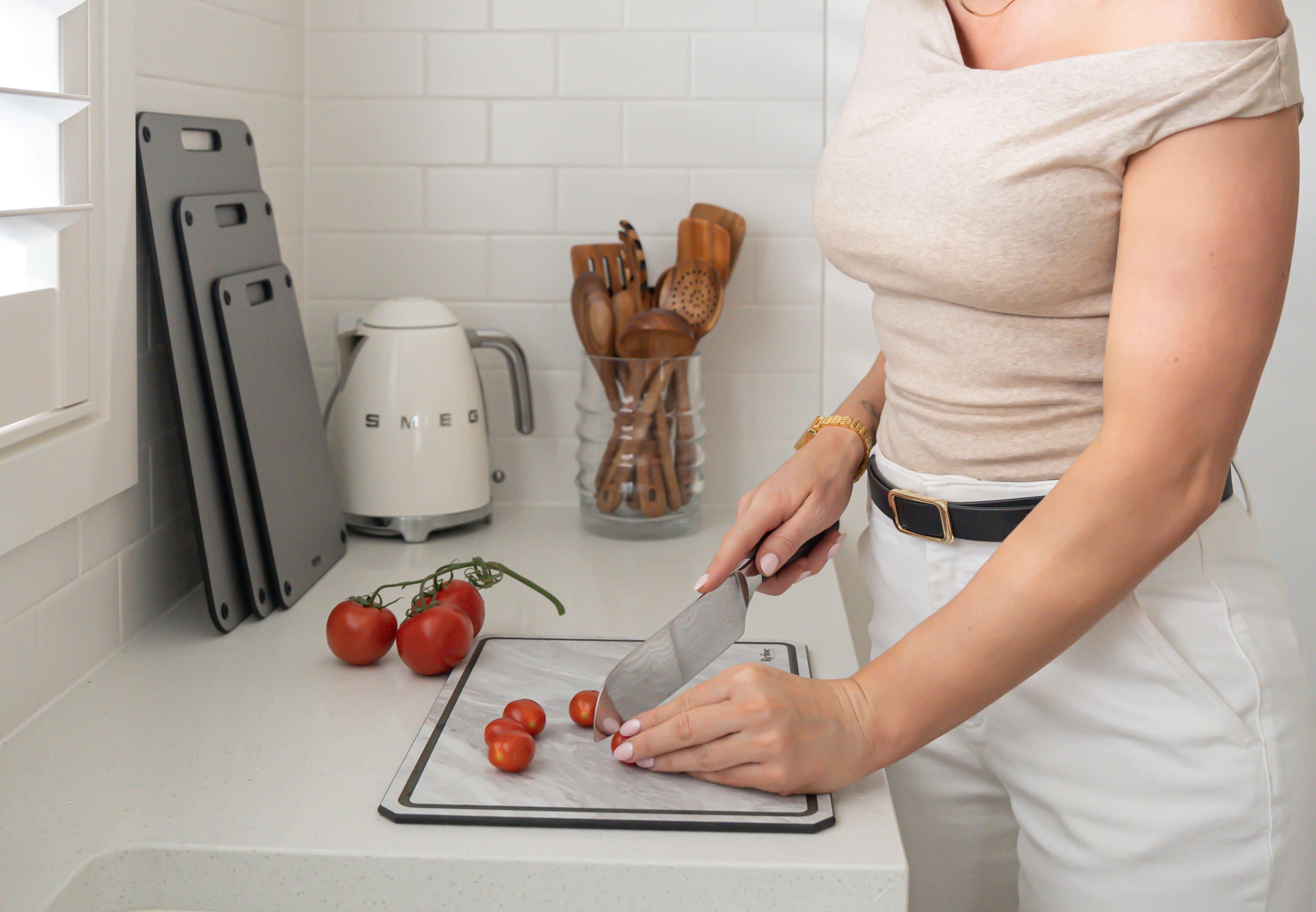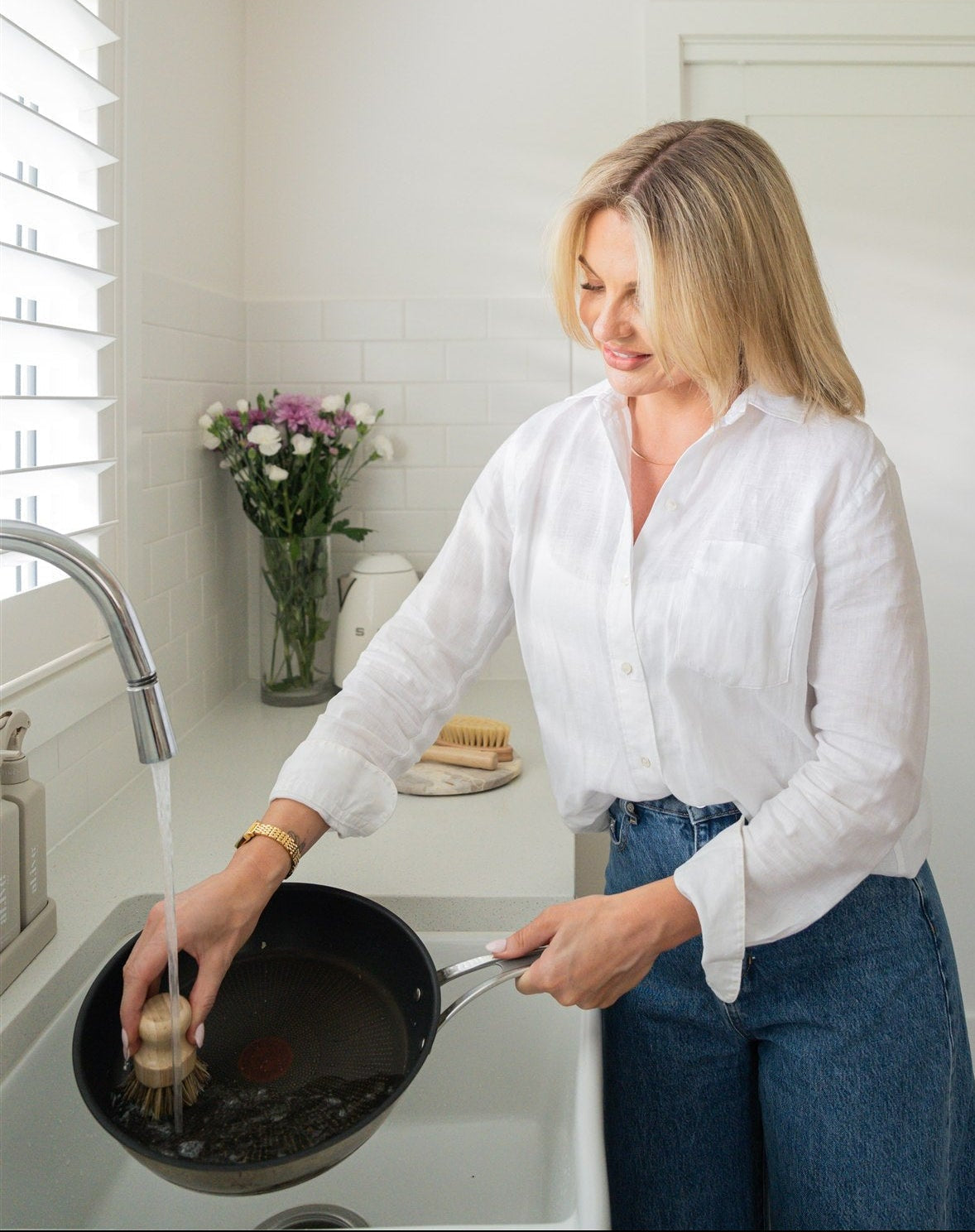
The kitchen is one of the most used spaces in the home — and one of the most important when it comes to supporting your health.
While much of the conversation around low-tox living focuses on food, what’s often overlooked are the everyday tools we use to clean the very surfaces our food touches.
From dish brushes to scrubbers, these small, frequently used items can play a bigger role than we realise.
Why your cleaning tools matter
Many conventional cleaning tools are made from synthetic materials, including plastics that can degrade over time with use.
With repeated exposure to water, friction, and heat, these materials can begin to break down — potentially contributing to microplastic exposure within the home environment. Research shows that dish sponges and brushes can release both microplastics and nanoplastics during use (Luo et al., 2022).
In fact, dish sponges have been found to release up to 6.5million microplastic fibres per gram during abrasive use (Su et al., 2024), highlighting just how significant this exposure can become over time.
Beyond material breakdown, these tools can also act as a reservoir for bacteria. Dish brushes and sponges have been shown to carry pathogenic bacteria such as Salmonella and Campylobacter (Luo et al., 2022), particularly when used repeatedly in damp environments.
Synthetic fibres themselves are often coated in chemical compounds, which may pose additional health considerations with regular handling (Chen et al., 2022). Microplastics can also transfer to humans through dermal contact (Prata et al., 2019; Li et al., 2023), reinforcing the importance of the materials we interact with daily.
While often overlooked, these tools come into direct contact with dishes, utensils, and surfaces used in food preparation — making them a meaningful place to start when refining your home environment.
What to look for in low-tox cleaning tools
When choosing more considered alternatives, look for:
- Natural fibres instead of synthetic bristles
- Plastic-free or low-plastic construction
- Durable materials designed for longevity
- Replaceable heads to reduce waste
Small changes here can create a meaningful shift over time.
Creating a more intentional cleaning ritual
Low-tox living isn’t about perfection — it’s about awareness and small, intentional choices.
By refining even the most routine parts of your day — like cleaning — you begin to create a home environment that better supports your long-term health.
At Refine Wellness, our Cleanse Collection was thoughtfully designed to bring this philosophy into the everyday — combining natural materials, functional design, and a more considered approach to cleaning.
Because even the smallest tools in your home should support the way you live.
Sources:
Chen, Y., Chen, Q., Zhang, Q., Zuo, C., & Shi, H. (2022). An Overview of Chemical Additives on (Micro)Plastic Fibers: Occurrence, Release, and Health Risks. Reviews of Environmental Contamination and Toxicology, 260. https://doi.org/10.1007/s44169-022-00023-9.
Li, Y., Tao, L., Wang, Q., Wang, F., Li, G., & Song, M. (2023). Potential Health Impact of Microplastics: A Review of Environmental Distribution, Human Exposure, and Toxic Effects. Environment & Health, 1, 249 - 257. https://doi.org/10.1021/envhealth.3c00052.
Luo, Y., Qi, F., Gibson, C., Lei, Y., & Fang, C. (2022). Investigating kitchen sponge-derived microplastics and nanoplastics with Raman imaging and multivariate analysis.. The Science of the total environment, 153963 . https://doi.org/10.1016/j.scitotenv.2022.153963.
Prata, J., Da Costa, J., Lopes, I., Duarte, A., & Rocha-Santos, T. (2019). Environmental exposure to microplastics: An overview on possible human health effects.. The Science of the total environment, 702, 134455 . https://doi.org/10.1016/j.scitotenv.2019.134455.
Su, Y., Yang, C., Wang, S., Li, H., Wu, Y., Xing, B., & Ji, R. (2024). Mechanochemical Formation of Poly(melamine-formaldehyde) Microplastic Fibers During Abrasion of Cleaning Sponges.. Environmental science & technology. https://doi.org/10.1021/acs.est.4c00846.